How Septra Turns Your Goals Into Weekly Work
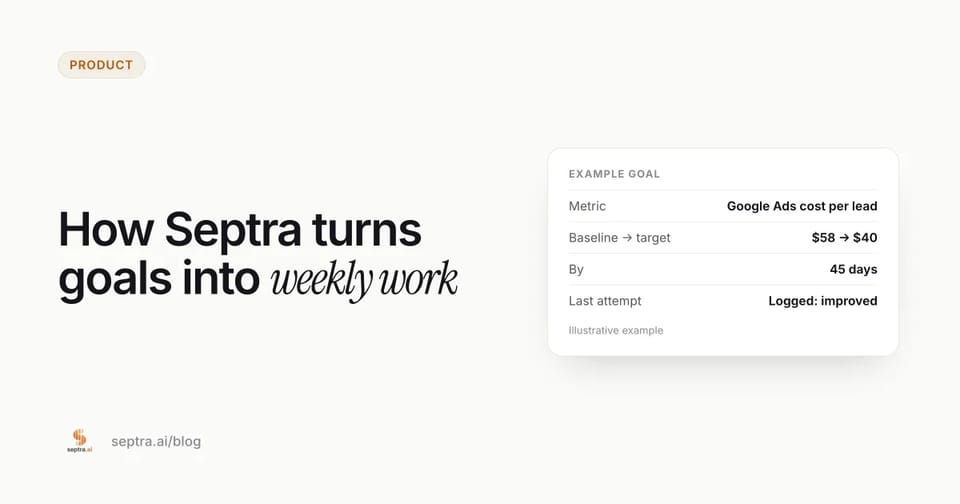
Short answer: in Septra, a goal is one metric (for example Google Ads cost per lead) with a baseline, a target, a direction and a date. Its current value updates from your connected data on every sync. Each week Ori, the AI CEO, reads every goal, works out which are off track and why, and assigns a few tasks to the specialist agents. Every attempt is logged and later marked improved, no change or worsened, so the team doesn't repeat what failed. Anything that spends more or goes public waits for your approval.
Last updated November 21, 2026.
What a goal contains
Field | Example |
|---|---|
Metric | Google Ads cost per lead ( |
Baseline and target | $58 to $40 |
Direction | Lower is better |
Target date | 45 days from now |
Priority and owner | High; paid ads |
Why | “Paid search is our main channel and CPL doubled since Q2” |
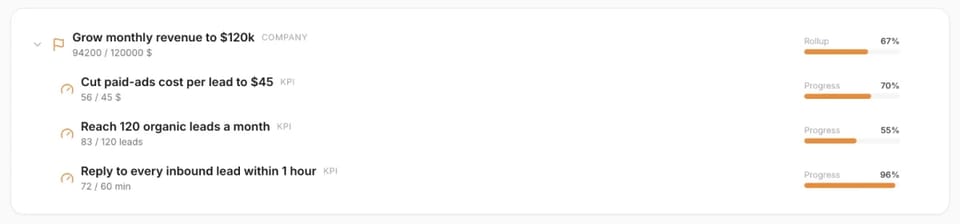
Supported live metrics include revenue, MRR, new customers, cost per lead, ROAS, organic sessions and conversion rate, computed from connected sources such as Stripe, Google Ads, GA4 and your CRM. For goals no system tracks (say, customer interviews done), you log progress by hand in chat. Goals sit in a tree, from one company goal down to channel KPIs.
How a goal becomes work
- Read. Ori checks each goal's current value, progress and how fresh its data is. Stale data is flagged before anything is decided.
- Diagnose. For off-track goals, it looks for the cause in your data: a search term burning budget, a page that lost rankings, a broken form.
- Assign. It delegates a small number of tasks to specialists such as Aria (paid ads) or Gale (growth), each linked to the goal and the expected effect.
- Log. It records the diagnosis and the tasks as an attempt.
- Review. Next cycle, it compares the metric with the attempt's starting point and marks it improved, no change or worsened, then doubles down or tries a different lever.
Some attempts are structured as experiments with a hypothesis and notes:
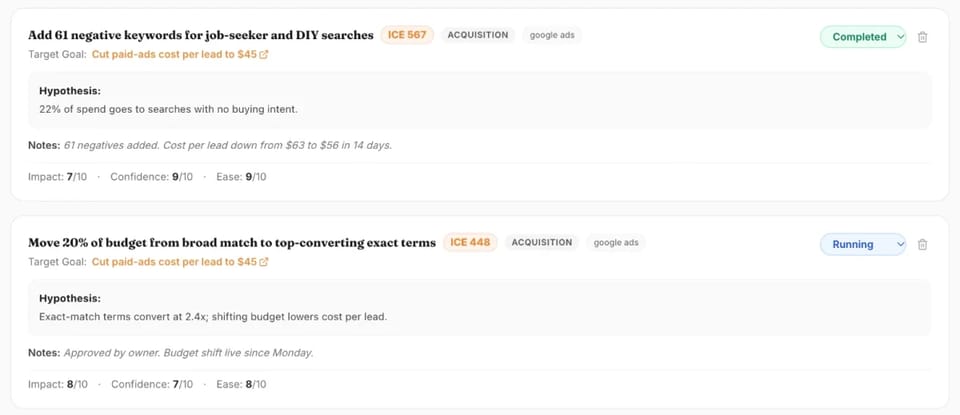
The screenshots use a fictional company's data.
Where you stay in control
- New goals start as drafts. Goals an agent suggests appear on the Goals page for you to confirm or discard.
- Target changes are proposals. An agent can propose raising a target or pausing a goal; nothing changes until you approve.
- Actions are gated by risk. Research, audits and drafts happen automatically. Publishing, social posts, budget or bid increases and campaign launches wait in the Inbox. Routine spend-neutral ad changes are applied and logged.
More detail: goals and KPIs guide and approval gates.
Writing goals that work
- One metric per goal. “More traffic and better conversion” is two goals.
- Use a connected metric when you can, so progress updates itself.
- Give it enough time. Paid and conversion goals need 30 to 60 days for enough data; SEO and AI-search goals usually need 60 to 90.
- Write the why. It helps the planner trade off goals against each other.
Not sure where to start? Septra's free goal-plan builder drafts goals from a description of your business, with no signup.
Frequently asked questions
What happens if my data source disconnects?
The goal is marked as having stale data and the planner flags it instead of making decisions on old numbers.
Can agents change my targets?
They can propose a change with a reason. Your goal stays as it is until you approve.
Which plan includes goals?
The Goals Engine plan ($30 the first month, then $750/month) includes goals, the weekly planning cycle and all seven AI employees. See pricing and how autonomous agents work.

Founder of Septra. Previously engineered core compute and auto scaling systems at AWS and Stripe.
Set your business goal. Put your AI team to work.
Seven autonomous AI employees plan, execute, and deliver results on a predictable weekly cadence.
Build my goal plan