Small Business AI Implementation Without a Technical Team: A Proven Playbook
If you run a small or midsize business, you’ve probably heard the same promise over and over: “AI will transform your operations.” But every time you look at the tools, you hit the same wall—you need a developer to connect them to your CRM, your ad accounts, or your inventory system. That wall is the real reason most SMBs never get past playing with ChatGPT.
Here’s the truth that the enterprise-focused AI vendors don’t want to admit: small business AI implementation without a technical team is not only possible, it’s already happening. In fact, the most successful SMBs are skipping the “hire a data scientist” step entirely. They’re using no-code automation platforms, pre-built integrations, and done-for-you strategy sessions to get the same results their larger competitors pay six-figure engineering salaries for.
This article isn’t theory. It’s a case-study driven playbook showing exactly how real small businesses deployed AI automation (HubSpot lead routing, Google Ads optimization, SEO content generation) without a single line of code. You’ll also learn the critical difference between generic AI advice and business-outcome-focused implementation—the kind Septra AI delivers every day.
Why “No Technical Team” No Longer Blocks AI Success
Three years ago, implementing AI required a dedicated engineering squad. Today, the landscape has flipped. Major AI providers—including Anthropic with its new Claude for Small Business—are now building products specifically for non-technical operators. Meanwhile, platforms like HubSpot and Odoo have opened API access that no-code tools can ride on.
The result? AI automation is becoming a plug-and-play utility for SMBs. But “available” and “implemented correctly” are two different things. Without a technical team, you still need a map—someone who understands your specific data flows, business rules, and desired outcomes.
That’s where the small business AI implementation without a technical team model shines: you don’t build the infrastructure yourself. You partner with experts who deploy the AI for you, using strategy sessions to define what automation will actually move your revenue needle.
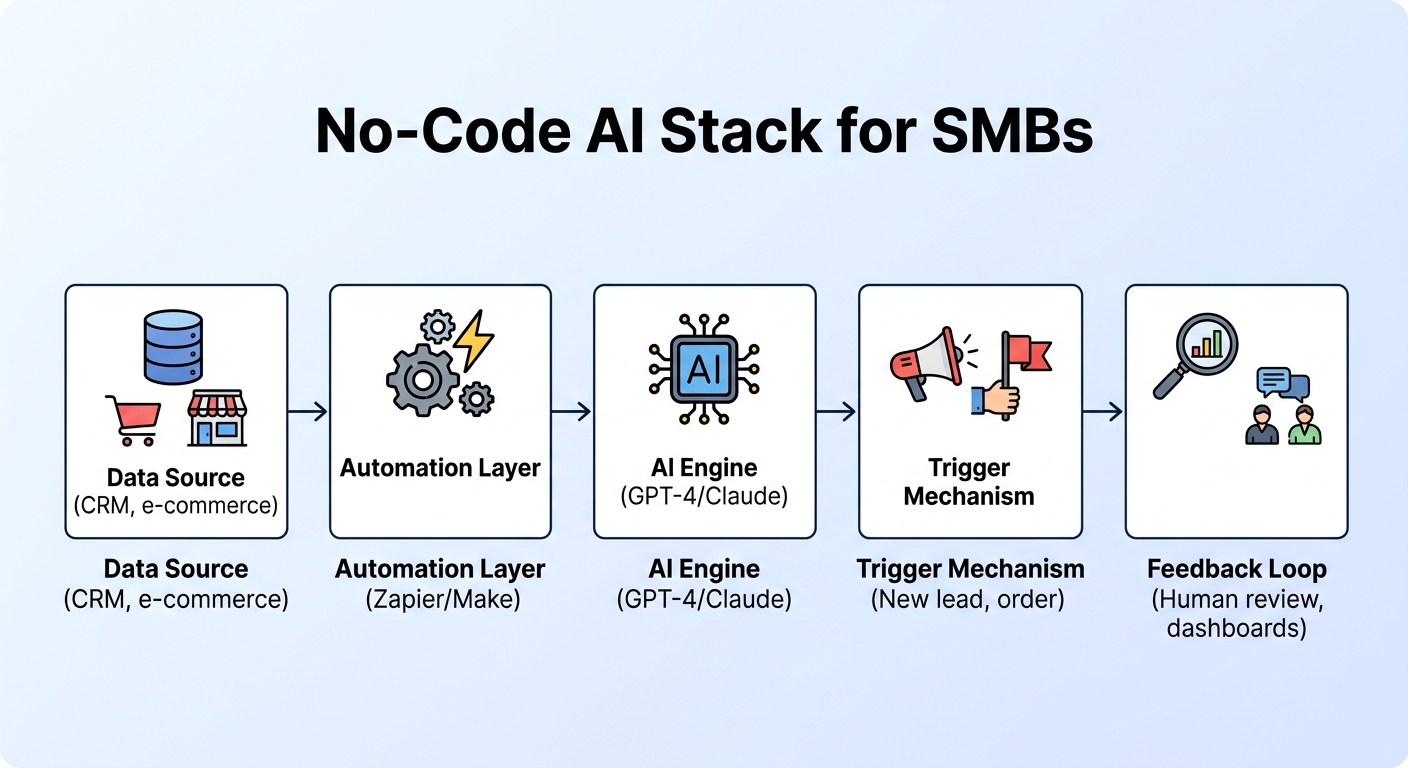
The Five Components Every No-Code AI Stack Needs
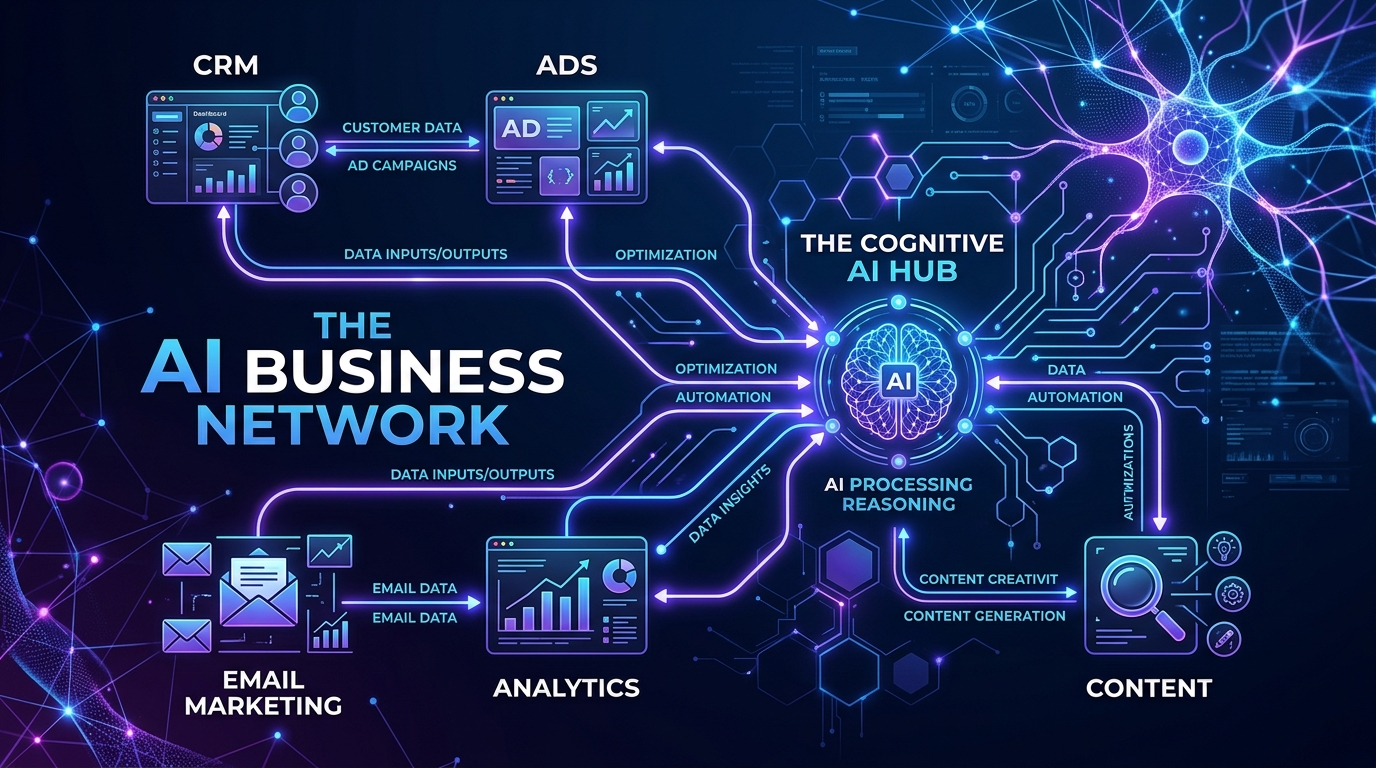
- A data source (your CRM, e-commerce platform, or spreadsheet)
- An automation layer (Zapier, Make.com, or a native connector)
- An AI engine (GPT-4, Claude, or a domain-specific model like SocialPost.ai)
- A trigger mechanism (new lead, order status change, scheduled time)
- A feedback loop (human review, performance dashboards, iteration)
Notice that “developer” doesn’t appear on that list. Every component can be configured by a business owner or operations manager with the right guidance.
The Real Roadblock: Integration, Not Implementation
Most SMBs fail at AI because they try to implement it in isolation—a chatbot here, a content generator there. The real power comes from connecting AI to your actual business systems: your HubSpot CRM, your Google Ads account, your Odoo inventory.
Integration anxiety is real. According to recent surveys, over 60% of small business owners say they worry about breaking existing workflows when introducing AI. That fear is justified—but it’s also the reason the done-for-you approach is winning.
Case Study 1: How a 12-Person Agency Automated Lead Routing with Zero Code
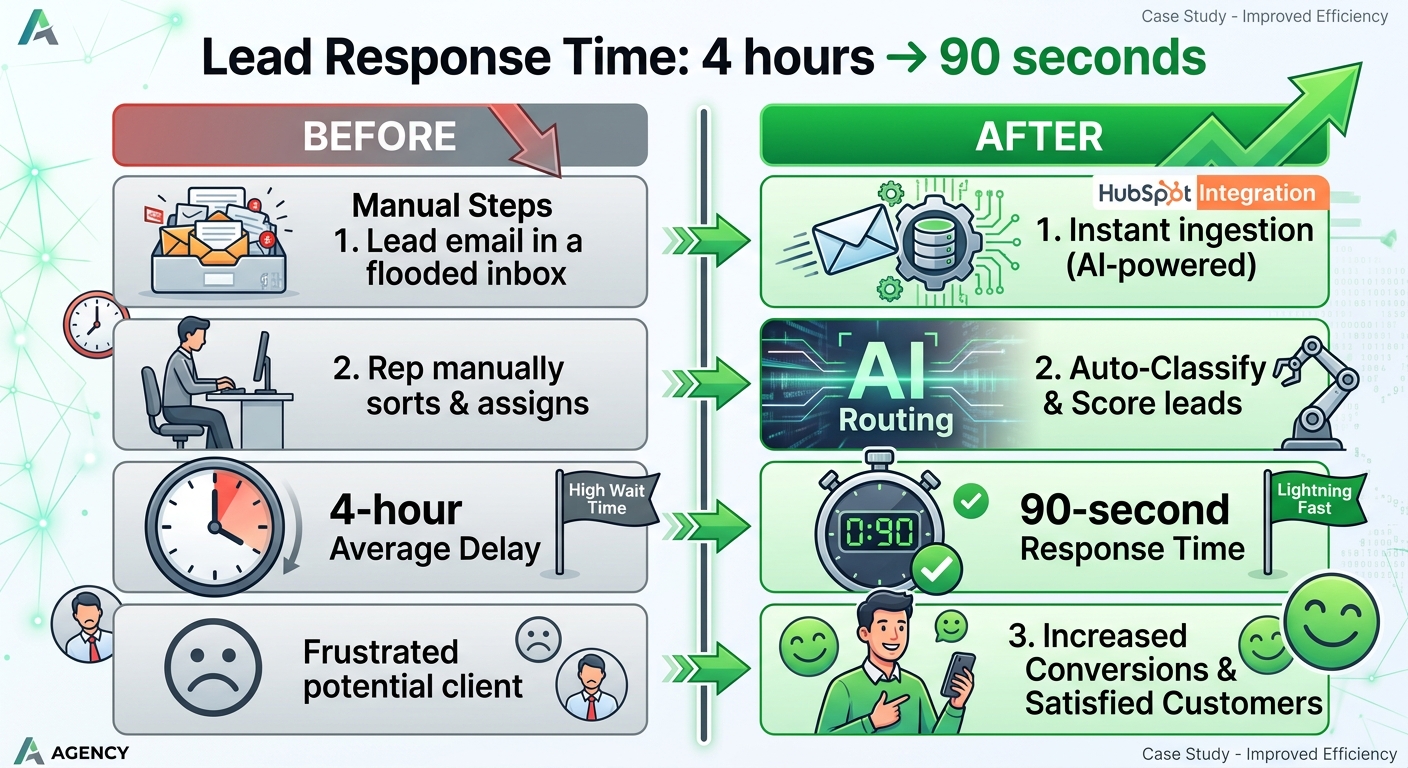
The Challenge: A digital marketing agency was manually triaging 200+ inbound leads per month from multiple sources (website chat, LinkedIn, Google Ads forms). Leads sat in email inboxes for hours before being assigned. Their CRM was HubSpot, but they didn’t have a developer to build complex workflows.
The Solution (Septra AI approach):
- A 90-minute strategy session mapped the exact lead routing rules: industry, budget size, urgency keywords.
- We connected their HubSpot CRM to a no-code automation platform using native integrations (no API coding).
- An AI model was trained to read the first message, classify the lead, and auto-assign it to the right account manager.
- Fallback logic: if confidence was below 85%, the lead went to a human review queue.
The Result: Lead response time dropped from 4 hours to 90 seconds. The agency closed 23% more deals in the first quarter—without hiring a single technical person.
This is small business AI implementation without a technical team in action. The owner didn’t touch a line of code. She attended two strategy sessions and her team started seeing ROI in under two weeks.
Case Study 2: A Retailer’s AI-Powered Google Ads Optimization Without a Developer
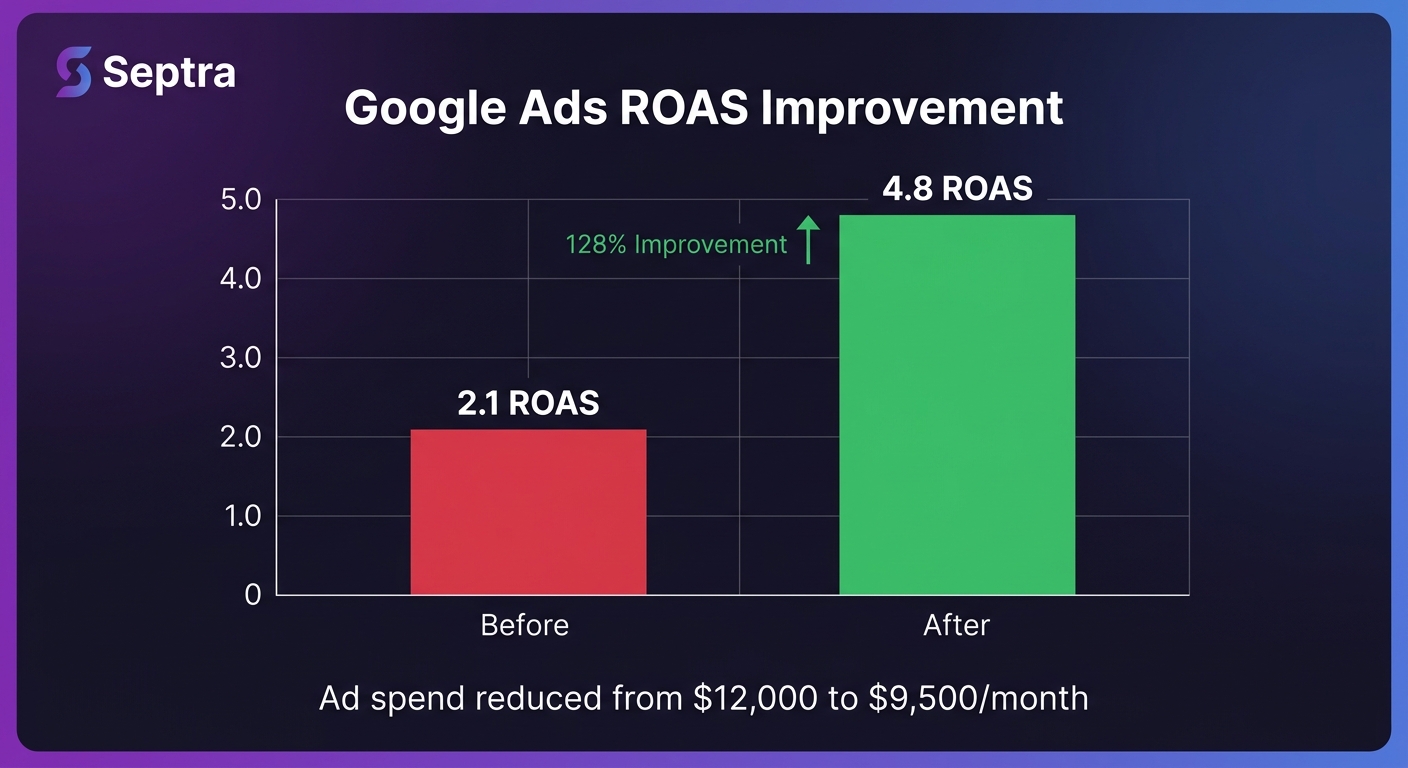
The Challenge: An e-commerce retailer with 500+ SKUs was running Google Shopping campaigns with manual bid adjustments. Their ad spend was bleeding—$12,000/month with a 2.1 ROAS. They knew AI could optimize bids, but every “AI ad tool” they tried required Custom Scripts in Google Ads or API access they couldn’t manage.
The Solution (Septra AI approach):
- We connected their Odoo inventory system directly to Google Ads via a pre-built connector.
- An AI engine was configured to monitor real-time stock levels, profit margins, and seasonality signals.
- Every hour, the AI adjusted bids: high-margin, in-stock items got +20% bid; low-margin/out-of-stock items got paused.
- The system also generated automated ad copy variations for best-selling products using the brand’s tone guidelines.
The Result: ROAS jumped from 2.1 to 4.8 in 60 days. Ad spend dropped to $9,500/month because wasted clicks were eliminated. The owner’s only technical involvement? Approving a weekly performance report.
The Done-For-You Alternative: Strategy Sessions + Hands-On Deployment
Both case studies share a common denominator: the business owners didn’t build the AI themselves. They invested in strategy sessions where an expert analyzed their workflows, then deployed the automation on their behalf.
This is the core of Septra AI’s model. We’re not selling you a subscription to a dashboard you’ll never configure. We sell outcomes—faster lead response, higher ROAS, less manual overhead—by doing the implementation work for you.
Why Strategy Sessions Matter More Than Tools
- Clarity: You define exactly what “success” looks like (e.g., “cut lead response time by 50%”)
- Feasibility: The expert identifies which data sources are clean enough for AI and which need cleanup
- Speed: No trial-and-error; the implementation path is pre-mapped
- Accountability: You get a timeline and a delivery milestone, not a vague “AI transformation” promise
What to Look for in an AI Implementation Partner (When You Don’t Have a Tech Team)
If you’re serious about small business AI implementation without a technical team, stop looking for a tool. Look for a partner that offers:
- Business-first strategy sessions (not tech demos)
- Pre-built connectors for your specific tools (HubSpot, Odoo, Google Ads)
- No-code deployment (you should never have to open a terminal)
- Results-driven milestones with clear KPIs
- Post-deployment support that includes training your existing staff, not replacing them
Red Flags to Avoid
- “Just connect our API and you’re done.” (Integration without strategy wastes money.)
- “You need to hire an AI engineer.” (That’s the old way.)
- “Our AI learns everything on its own.” (Untrained models are worse than nothing.)
FAQ: Small Business AI Implementation Without a Technical Team
Q: Can I really implement AI without any coding skills?
A: Yes. With no-code platforms and done-for-you services, you can automate CRM workflows, ad optimization, and content generation without writing a single line of code. The key is partnering with experts who configure the AI for your specific data.
Q: How long does a typical implementation take?
A: Most integrations take 1-3 weeks from strategy session to live deployment. Complex multi-step workflows may take 4-6 weeks. The fastest wins often come from connecting your CRM to your communication channels.
Q: What if my data is messy or incomplete?
A: A good implementation partner will audit your data during the strategy session and recommend cleanup steps before AI goes live. You don’t need perfect data, but you do need a plan for gaps.
Q: How much does a done-for-you AI setup cost?
A: Costs vary by scope, but most SMB spend between $2,000–$10,000 for initial strategy and deployment. Compare that to hiring a full-time developer at $80,000+/year. The ROI from even one automated workflow often covers the investment in the first month.
Conclusion: Your Next Step to AI-Powered Growth
You don’t need a technical team to harness AI. You need a clear business goal, a willingness to let experts handle the configuration, and a partner who delivers outcomes—not just dashboards.
Small business AI implementation without a technical team is not a compromise. It’s a smarter path. By focusing on strategy-led, done-for-you deployment, you get enterprise-grade automation with SMB-level investment.
Ready to see what AI could do for your specific workflows? Book a free strategy session with Septra AI. We’ll map your current operations, identify three automation wins, and lay out a timeline—no commitment, no technical jargon. Just results.
Ready to build your own AI app?