Generative Engine Optimization (GEO): A Practical Guide
Short answer: generative engine optimization (GEO) is the work of getting your brand named and cited when people ask AI assistants like ChatGPT, Gemini and Perplexity for recommendations. It overlaps heavily with SEO: the engines that search the web still need to find, read and trust your pages. What changes is the scoreboard (mentions and citations instead of rank positions) and how much third-party pages about you matter.
Last updated November 21, 2026.
Where the term comes from
The name comes from a 2024 paper by researchers at Princeton, Georgia Tech, the Allen Institute and IIT Delhi, published at KDD (Aggarwal et al., arXiv 2311.09735). They built a benchmark of queries, rewrote source pages in different ways and measured how often each version was used in generated answers. Adding citations, quotations from credible sources and statistics improved visibility the most in their tests; keyword stuffing did not help.
Two cautions about that paper. It tested a research setup, not the live ChatGPT or Perplexity products. And the engines have changed a lot since. Treat it as evidence that content quality and verifiability matter, not as a recipe.
How AI answers pick sources
When an assistant answers with web results, the process is roughly the same across products:
- Retrieve. The assistant runs one or more searches and fetches candidate pages. ChatGPT search uses OpenAI's own crawler (OAI-SearchBot) plus search partners; Perplexity uses PerplexityBot; Google's AI Overviews and AI Mode draw on Google's index.
- Read. It extracts text from those pages. Pages that need JavaScript to render, or that block the crawler, may never be read.
- Write. The model drafts an answer from what it read and its training.
- Cite. It links some of the pages it used. Engines differ a lot in how often they link.
Google states plainly that there is nothing special to do for AI Overviews beyond normal SEO: pages must be indexed and eligible for snippets (Google Search Central). For the other engines, the same basics apply plus one more: being mentioned on the pages they retrieve.
GEO vs SEO
SEO | GEO | |
|---|---|---|
What you measure | Rankings, clicks, impressions | Mentions, citations, share of answers |
Where results show | Search result pages | Assistant answers |
What matters most | Your pages and links to them | Your pages plus third-party pages about you |
How stable | Fairly stable day to day | Answers vary between runs |
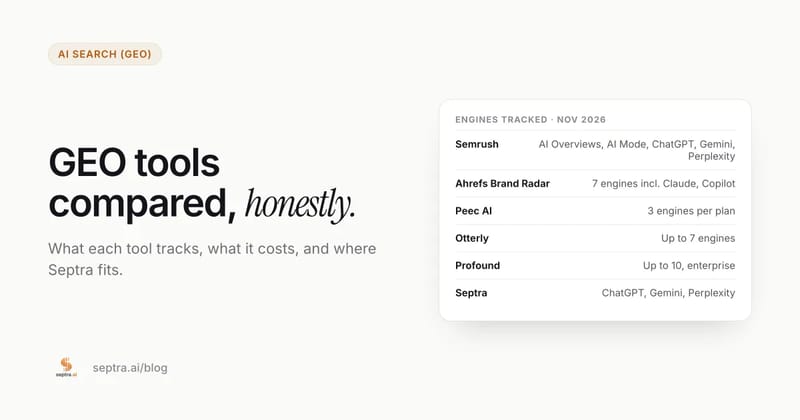
Tools | Search Console, rank trackers | Prompt trackers (see our GEO tools comparison) |
If your SEO is weak, start there. A page that isn't indexed or readable won't be cited either.
What actually moves AI visibility
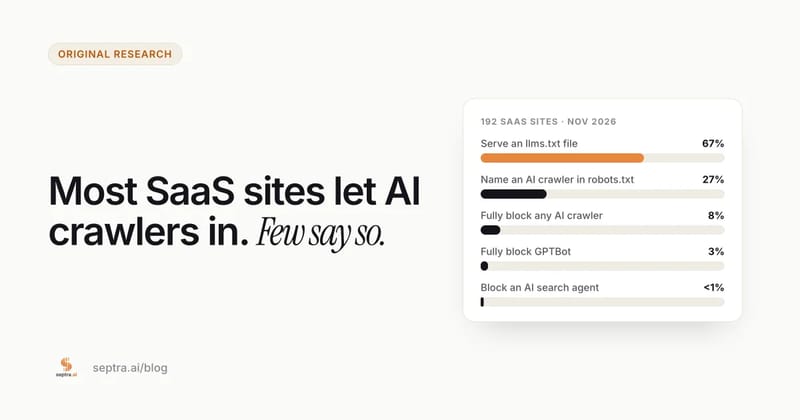
Be readable. Let the AI search crawlers in, and put key facts in the HTML. In our November 2026 study of 192 SaaS sites, only one blocked an AI search crawler in robots.txt, but firewalls and JavaScript-only pages still hide content.
Be specific and checkable. Answer the question in the first sentences under each heading. State facts with numbers, dates and sources. Pages that read like brochures give an engine nothing to quote.
Be on the pages engines already cite. For “best X for Y” questions, assistants lean on comparison articles, directories, review sites and community threads. Our AI citation playbook covers how to earn those mentions without paying for them.
Be consistent. Describe your product the same way on your site, LinkedIn, directories and docs, so the facts engines read about you agree.
Keep pages current, honestly. Update pages when the facts change and show the update date. Don't change dates without changing content; Google's guidance on dates asks for the date to reflect real updates (Google Search Central).
How to measure it
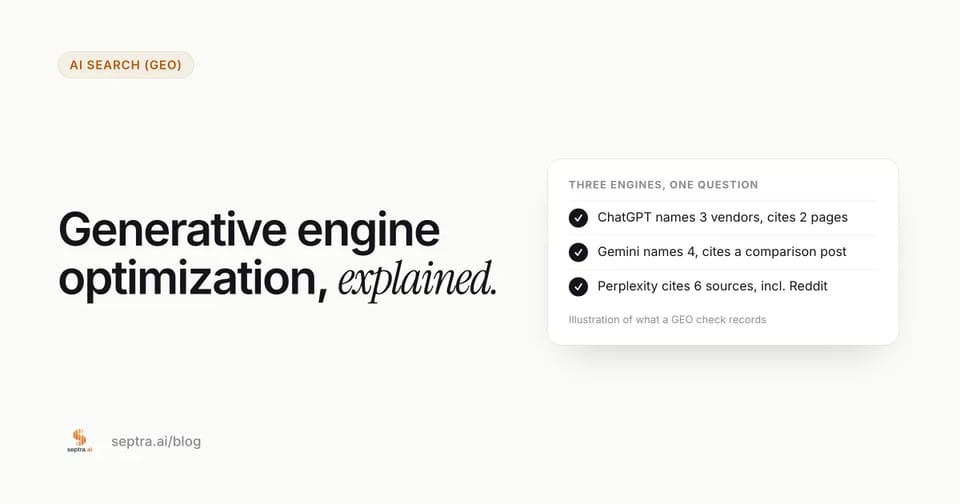
Pick 10 to 20 questions your buyers ask, run them in ChatGPT, Gemini and Perplexity, and record for each answer: were you named, were you linked, and who was named instead. Repeat on the same day each week or month. Answers vary between runs, so watch the trend, not a single answer.
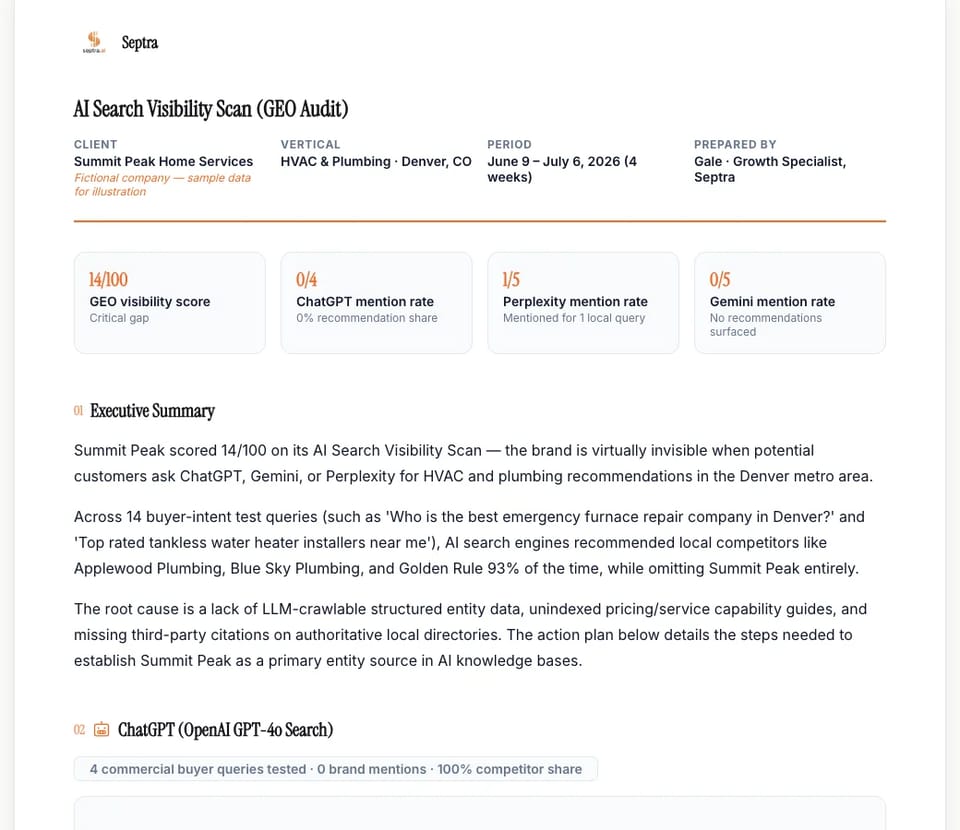
The screenshot above is from a Septra sample GEO report for a fictional company. Septra's free GEO scan runs a smaller version on your own site.
A 30-day plan
- Week 1: baseline. Run your question set in all three engines and record mentions, links and competitors.
- Week 2: access. Check robots.txt, your bot-management settings and whether key pages render without JavaScript.
- Week 3: one great page. Improve the page that should win your most valuable question: answer first, add specifics and sources, add an FAQ.
- Week 4: one outside mention. Get listed or corrected on one directory or comparison page that engines already cite for that question. Then rerun the baseline.
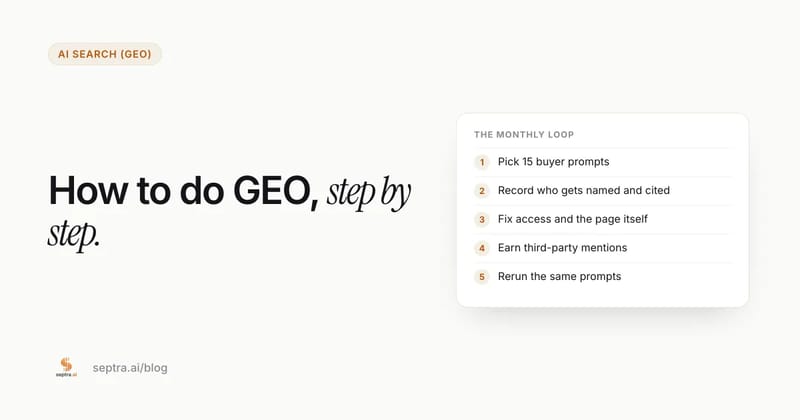
The longer version of this plan is in how to do GEO, step by step.
Frequently asked questions
Is GEO replacing SEO?
No. Search engines still send most discovery traffic, and the AI engines that browse the web rely on search indexes. GEO adds a second scoreboard and makes off-site mentions more important.
How long does GEO take to show results?
Engines that search live (Perplexity, ChatGPT search) can pick up a new or improved page within days to weeks once it is indexed. Changing what a model knows from training takes much longer and is outside your control.
Do I need schema markup for GEO?
It helps search engines understand a page, and it is cheap to add, but no AI provider has said structured data decides citations. Clear, specific text matters more.
Does llms.txt help?
No major AI provider documents using it. It is harmless to publish, but don't expect it to change answers.
Sources
- Aggarwal et al., “GEO: Generative Engine Optimization”, KDD 2024: arxiv.org/abs/2311.09735
- Google Search Central, AI features and your website: developers.google.com
- Google Search Central, Influencing your bylines and dates: developers.google.com
- OpenAI, Overview of OpenAI crawlers: platform.openai.com/docs/bots
- Perplexity crawlers: docs.perplexity.ai

Founder of Septra. Previously engineered core compute and auto scaling systems at AWS and Stripe.
Set your business goal. Put your AI team to work.
Seven autonomous AI employees plan, execute, and deliver results on a predictable weekly cadence.
Build my goal plan