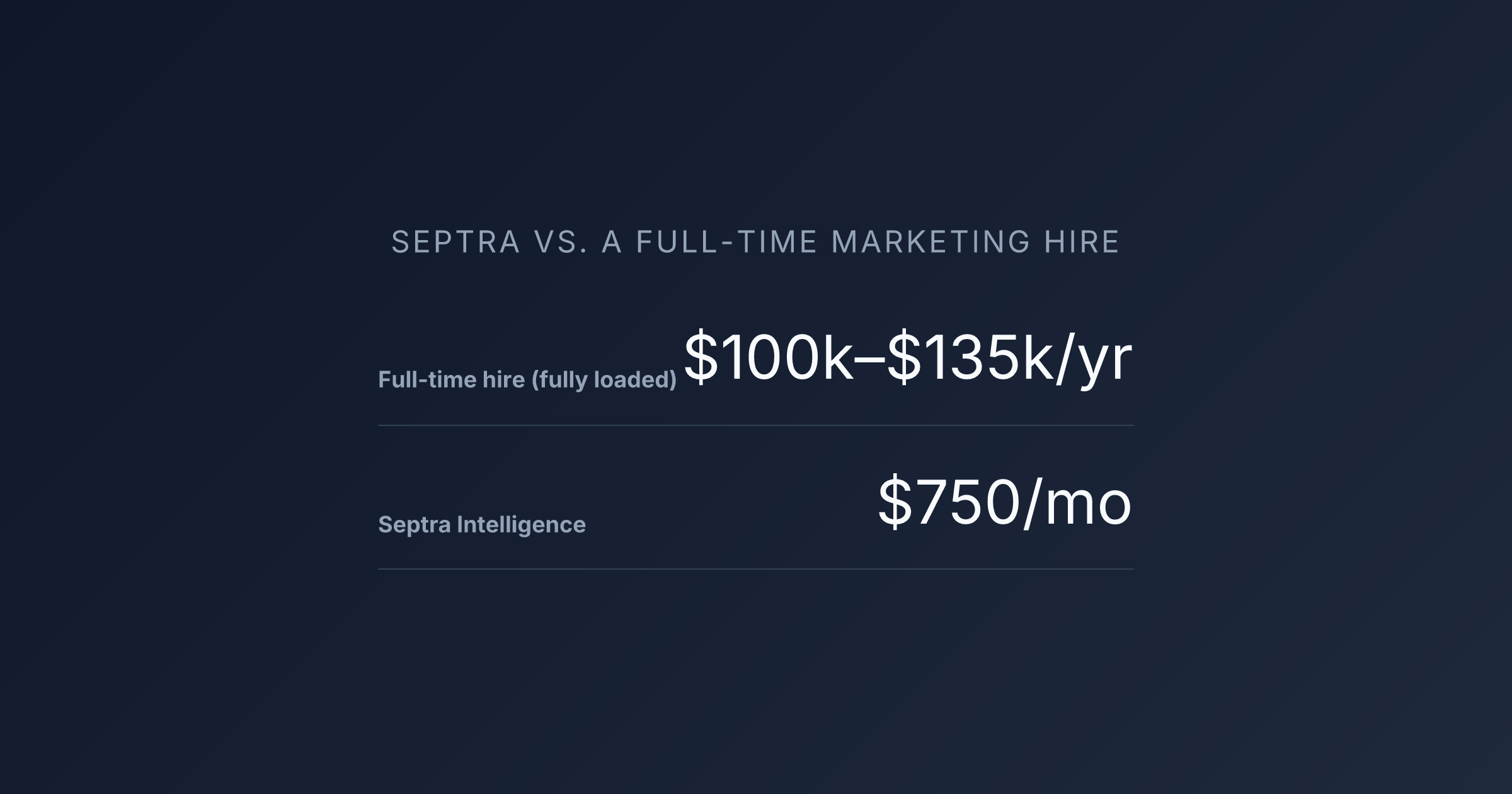
If you're weighing whether to hire your first full-time marketing person, the real question isn't "can I afford the salary?" — it's "what am I actually getting for the total cost, and how much of it will actually get covered?" A full-time marketing generalist or manager in the U.S. typically costs $100,000–$135,000 a year once you add benefits, payroll taxes, tools, and ramp time — and most of that buys you real depth in just one or two channels. Septra's Intelligence plan runs an entire team of marketing agents across SEO, paid ads, CRO, AI-search visibility, competitor tracking, and content for $750 a month. This post lays out the honest comparison: what each option costs, what each actually covers, and where a human hire still wins.
The real cost of a full-time marketing hire
Most founders budget for a salary and stop there. The fully loaded cost is 30–40% higher. Here's the breakdown for a typical first marketing generalist/manager hire at a small or mid-size company:
Cost component | Typical range |
|---|---|
Base salary (generalist/manager) | $70,000–$90,000 / yr |
Benefits + payroll taxes (roughly 30%) | $21,000–$27,000 / yr |
Marketing tool stack | $5,000–$12,000 / yr |
Recruiting + onboarding (one-time) | $5,000–$10,000 |
Management overhead | Founder or lead hours, every week |
A note on the salary figure: the BLS median for "marketing managers" sits around $167,000 a year, but that skews toward management roles at larger companies. A realistic first full-time marketing hire at an SMB lands in the $70,000–$90,000 base range — Glassdoor's marketing-manager average total pay is roughly $105,000 including bonus. The point isn't the exact number; it's that the *loaded* cost is always well above the sticker salary.
The multiplier comes from real data. The Bureau of Labor Statistics' Employer Costs for Employee Compensation consistently shows benefits at roughly 30% of total compensation, which is why the fully loaded cost of an employee runs 1.3–1.4x base salary. And the tool stack adds up fast — one survey of 1,402 marketing tools put the average team's marketing SaaS spend at about $12,000 a year, and even a single hire needs a CRM, email platform, social scheduler, analytics, and design tools.
Add it up and a first full-time marketing hire realistically costs $100,000–$135,000+ in year one — before factoring in ramp time.
What one full-time hire can actually cover
A full-time marketing hire is exactly that: one person, roughly 40 productive hours a week. In practice, one person can be genuinely strong at one or two channels — not six.
- A generalist might do content and SEO reasonably well, while paid ads and CRO get neglected.
- A performance marketer might run Google and Meta well, while content, email, and SEO stall.
- Everything else — reporting, competitor tracking, AI-search visibility, day-to-day monitoring — either doesn't happen or happens reactively.
The BLS projects marketing-manager employment growth of about 6% over the next decade, which is also roughly the rate at which good marketers get poached. A single hire is a single point of failure: when they're sick, on vacation, or leave (and marketing tenure tends to be short), the pipeline stalls and you start the 3–6 month ramp all over again.
Ramp time is the hidden cost. Most organizations budget three to six months before a new marketing hire is fully productive — learning the product, the customers, the stack, and the data. That's real money spent before real output arrives.
What Septra's agents cover in parallel
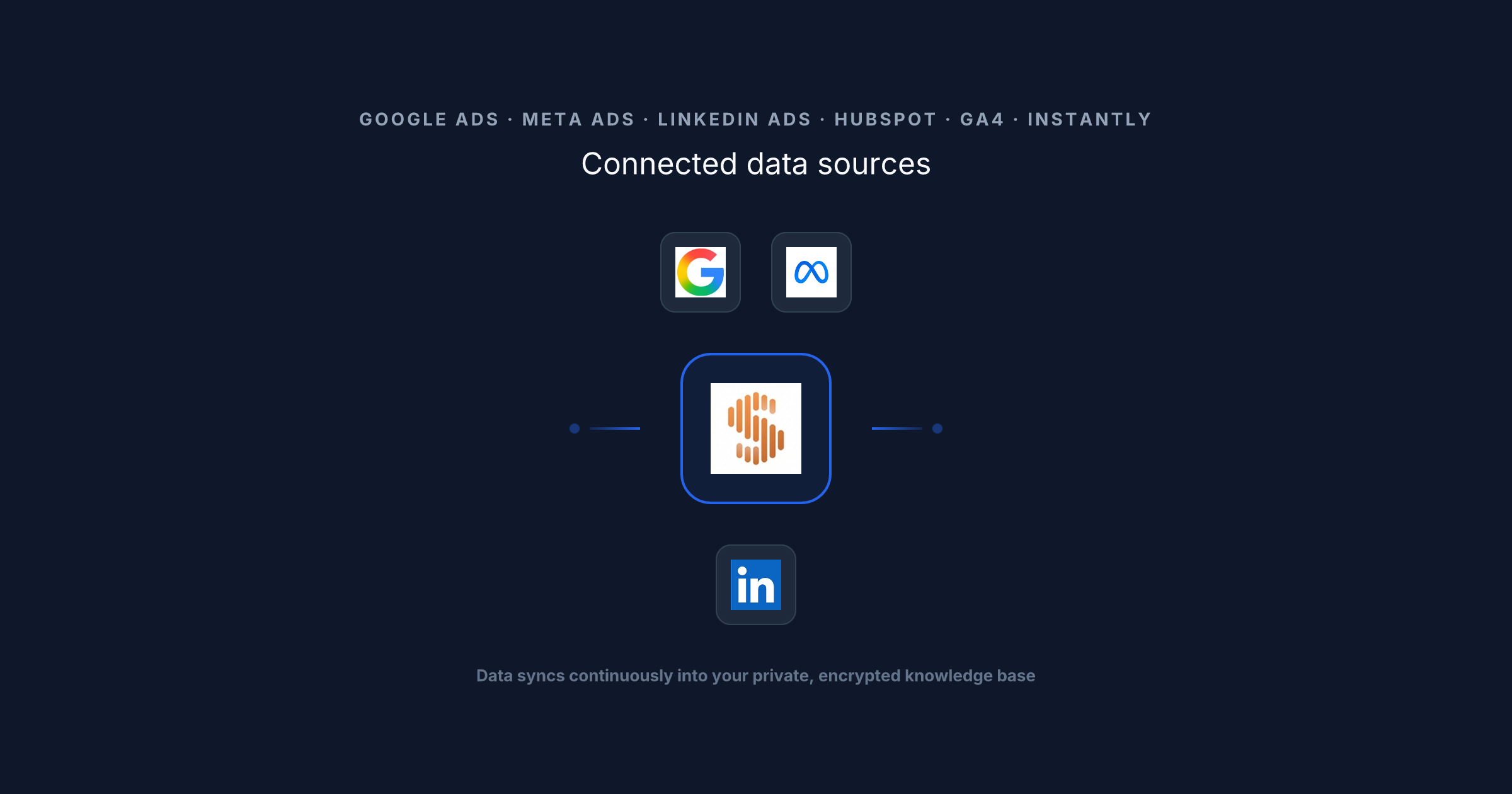
Septra builds a private Company AI Brain from the tools you already use — Google Ads, Meta Ads, LinkedIn Ads, GA4/Search Console, HubSpot, Instantly, and more — then deploys a team of specialized agents that work from that data every day, without waiting to be asked.
- Sage (CMO) — weekly strategy reviews, daily monitoring, and campaign briefs.
- Gale (Growth) — SEO, CRO, content, social publishing, and platform launches.
- Aria (Paid Ads) — Google, Meta, and LinkedIn optimization and budget reallocation.
- Milo (Content Creator) — image generation for ads, social, and blog.
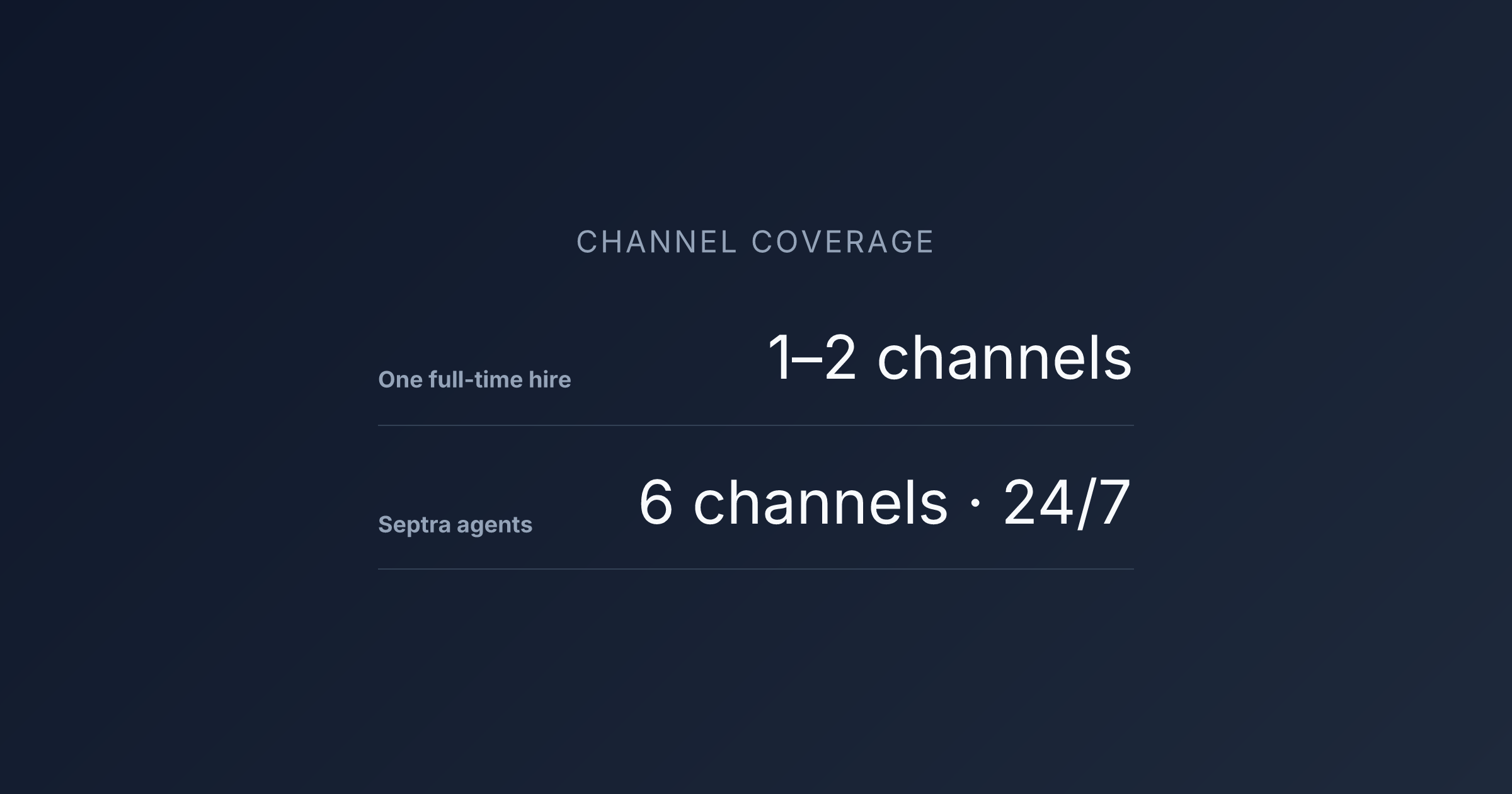
Because they're grounded in your real account data rather than a blank prompt, the agents cover six channels in parallel:
- SEO and content, grounded in what people are actually searching for.
- Paid ads optimization across Google, Meta, and LinkedIn.
- CRO and landing-page audits.
- GEO / AI-search visibility — are you cited when prospects ask ChatGPT, Gemini, or Perplexity?
- Competitor tracking and weekly intelligence digests.
- Reporting and daily monitoring that flags problems like wasted ad spend before they cost you money.
That's the key asymmetry: a hire gives you depth in one or two areas; Septra gives you breadth and constant monitoring across all six, around the clock, for a fraction of the cost.
The comparison at a glance
Dimension | Full-time marketing hire | Septra Intelligence |
|---|---|---|
Cost | $100k–$135k+ / yr loaded | $750 / mo (about $9k / yr) |
Time to productivity | 3–6 month ramp | Minutes to connect, days to value |
Channel coverage | 1–2 channels deep | 6 channels in parallel |
Availability | Roughly 40 hrs / wk, one person | 24/7, no sick days |
Scalability | Hire again to scale | Scales with plans, not headcount |
Turnover risk | High — single point of failure | None — institutional memory |
The honest tradeoffs: where a human hire still wins
This is not a "replace your hire with software" pitch. A good full-time marketer brings things agents don't:
- Judgment and taste — knowing when a campaign idea is off-brand or tone-deaf in a way a model can't always catch.
- Stakeholder relationships — sitting in leadership meetings, reading the room, and aligning marketing to sales and product.
- Creative and strategic direction — setting the vision, choosing which bets to take, and owning accountability.
Septra is built to cover the execution and monitoring layer underneath that leadership, not to replace it. The agents write the reports, flag the problems, draft the content, and monitor the channels around the clock — so the human (whether that's you, a founder, or the marketer you eventually hire) spends time on strategy and relationships instead of assembling spreadsheets and checking dashboards.
In practice, the strongest setups pair the two: a strategic owner setting direction, with Septra running the daily execution and monitoring in parallel. For many teams the right first step isn't a six-figure hire at all — it's getting the monitoring and reporting layer running now, then hiring strategically later with real data about where the gaps actually are.
Frequently asked questions
What does it really cost to hire a full-time marketing manager?
Plan for $100,000–$135,000+ a year once benefits (about 30% of compensation), payroll taxes, a $5,000–$12,000 tool stack, and recruiting/onboarding are included — and that's before the 3–6 month ramp to full productivity.
How much does Septra cost?
Free to start. $99/mo gets you automated daily audit reports across your connected accounts; $750/mo adds the full agent team (CMO, Growth, Paid Ads) that can act on what it finds. See the pricing page for the full breakdown.
Can Septra replace a full-time marketer entirely?
Not the strategic layer. Septra replaces the execution and monitoring work — reporting, auditing, drafting, optimization, daily checks — but a human still sets direction, approves spend, and owns stakeholder relationships. Most teams get the best results pairing the two.
Which channels do Septra's agents cover?
SEO and content, paid ads (Google, Meta, LinkedIn), CRO, GEO/AI-search visibility, competitor tracking, and reporting/monitoring — all grounded in your connected ad accounts, analytics, CRM, and email tools.
How long does Septra take to set up?
Connecting your accounts takes under 10 minutes. Once connected, Septra indexes your data into your Company AI Brain and the agents start working — versus three to six months to ramp a new hire.
What if I still want to hire a marketer later?
That's the smart path for many teams. Start with Septra to get monitoring and reporting running now, then use the data it surfaces to hire for the specific gap — a paid-ads specialist or a content lead — instead of a generalist guessing at everything.
Ready to compare your numbers?
Before you write a six-figure offer letter, see what an agent team costs and covers. Book a free strategy call and we'll map Septra against your actual marketing needs — or start free and watch your Company AI Brain build itself from the tools you already use.


